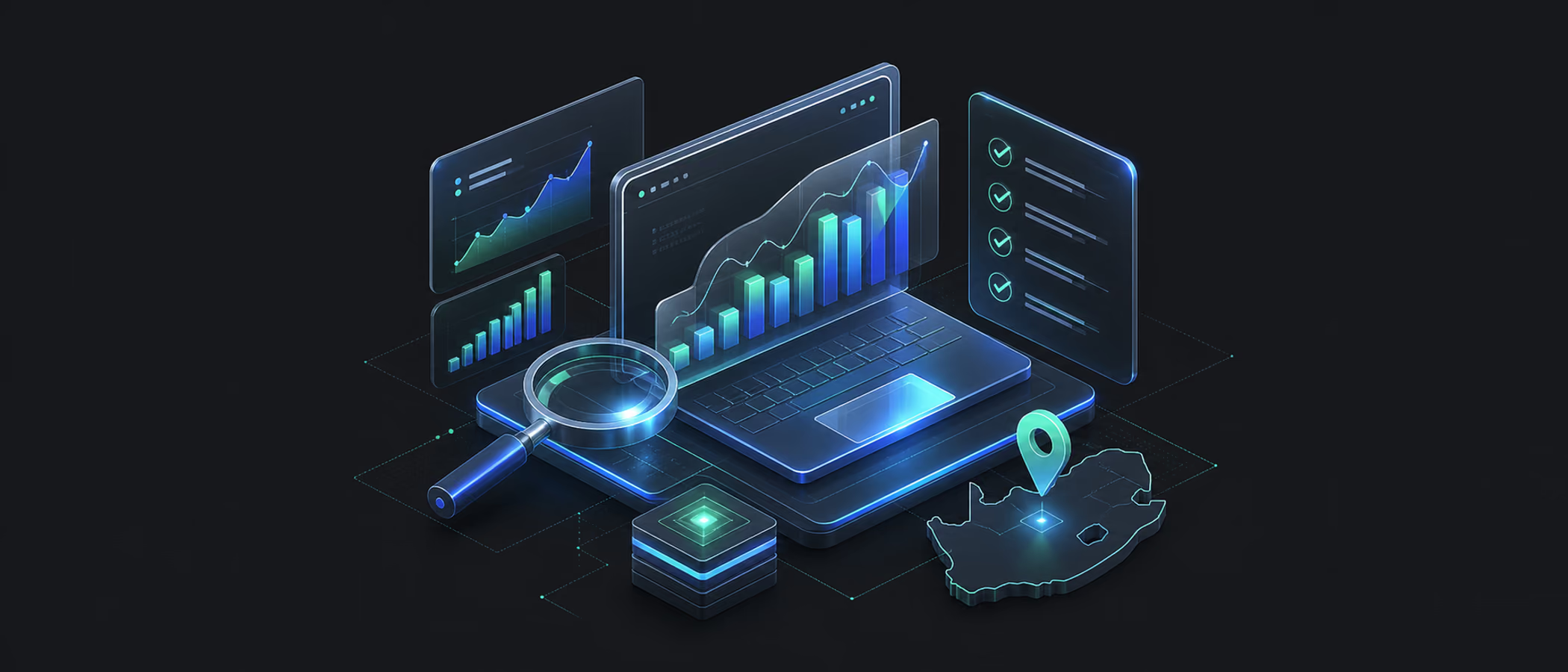

AI search assistants now synthesize answers directly for users, changing how brands get found online. Traditional search engine optimization focuses on ranking links, but Generative Engine Optimization (GEO) and Answer Engine Optimization (AEO) require brands to be cited in conversational search results.
South African companies face distinct local challenges, from regional language variations to localized search databases. Tracking and improving your AI search visibility helps keep your brand visible when local customers search ChatGPT, Gemini, or Google AI Overviews.
This review outlines the top tools for monitoring and building your AI search presence. We explain the features, costs, and geographic capabilities of each platform to guide your team's selection. If you need hands-on assistance setting up these workflows, you can hire a specialist for freelance AI SEO services. For more analyses on search optimization, browse our SEO blog or explore our dedicated LLM SEO & Trends hub.
Key Takeaways
- AI search visibility in South Africa requires local geographic targeting and proxy configurations.
- Conversational tracking tools use automated browsers to capture authentic user responses and citations.
- Optimization tools focus on structured data, entity building, and machine-readable standards like llms.txt.
- Localized tracking assists brands in defending their share of citation against regional competitors.
How We Chose the Best AI Search Tools
To evaluate the best tools for tracking and boosting AI search visibility, we applied five strict standards:
- Multi-Engine Coverage: The platform must track major AI interfaces, including Google AI Overviews, ChatGPT Search, Perplexity, Gemini, and Claude.
- South African Localization: We assessed whether the tool can handle localized search data, target google.co.za, run regional queries, or support South African search contexts.
- Data Accuracy: We reviewed the collection method (automated browser execution versus simple SERP scraping) to confirm the data is reliable.
- Actionable Features: We prioritized platforms that display data and provide tools to optimize content, generate structured data, or resolve entity issues.
- Cost Value: We examined pricing structures to find tools that fit various budgets, from small businesses to large enterprises.
South Africa Localization Capabilities
Optimizing for AI search within South Africa requires specific technical setups. Standard global SEO strategies often fail to capture localized search variations. Local businesses must address four key localization areas:
1. Regional Search Tracking
Traditional rank tracking platforms must target Google's local domain (google.co.za). SE Ranking, for example, allows teams to track search results down to specific South African cities or postal codes.
2. Residential Proxy Networks
AI assistants adjust their answers based on the user's geographic IP address. Scraping systems and visibility checkers use South African residential proxies (located in hubs like Johannesburg or Cape Town) to observe what local users see.
3. Local RAG Grounding
AI engines use Retrieval-Augmented Generation (RAG) to fetch current data. To appear in these local indexes, your content must use local terminology, ZAR currency symbols, and register with local South African business directories.
4. Multilingual and Local Nuances
South Africa's diverse language environment means search queries vary. Platforms like Cited Brands use custom multilingual testing methodologies to track how brands perform across different local query variations.
Category 1: Tools for Tracking AI Search Visibility
1. BrandAxis - Best for affordable South African AI visibility tracking
- Research Points:
- Location/Coverage: South Africa and global coverage. BrandAxis is a Cape Town-built AI search analytics platform with city-level tracking and broad international coverage.
- Key Features / USPs: Tracks AI visibility, rank, sentiment, competitor visibility, and source citations across ChatGPT, Google AI Overviews, and Perplexity on paid tiers.
- History / Reputation: Founded in 2025 by Felix Norton and Freddie O'Donnell, with a product focus on making AI visibility tracking more accessible for brands and agencies.
- Best For: South African businesses, agencies, and marketing teams that want affordable AI visibility monitoring without jumping straight into enterprise-level pricing.
- Standout Strengths:
- Tracks prompts daily across the core AI search engines included in paid plans.
- Includes source citation tracking, sentiment analysis, competitor benchmarking, and city-level tracking.
- Offers a free tier for early testing before committing to a paid plan.
- Shows ZAR reference pricing, which makes budgeting easier for South African teams.
- Pros & Cons:
- Pros: Cape Town-built; affordable entry-level pricing; daily refreshes; useful mix of visibility, sentiment, competitor, and citation data.
- Cons: Lower paid tiers focus on three core models; broader model coverage is reserved for Enterprise. Some advanced features, including optimization recommendations, misinformation alerts, and disinformation detection, are still marked as coming soon.
- Differentiators: BrandAxis positions itself as a lower-cost alternative to platforms like Peec or Promptwatch, with the same core AI visibility tracking concept but pricing aimed at being roughly 30% below competitors.
- Pricing/Cost Note: Free tier includes 5 prompts and ChatGPT-only tracking. Paid monthly plans currently show Lite from $19/month, Starter from $69/month, Pro from $169/month, and Advanced from $349/month, with ZAR shown for guidance.
- How to Get Started: Start with the free tier or choose a paid plan at BrandAxis.
- Verdict: A strong local addition for South African businesses that want AI search visibility tracking, citation insights, and sentiment monitoring at a more accessible price point than many international GEO platforms.
2. Cited Brands - Dedicated AI search reputation monitoring for local enterprises
- Research Points:
- Location/Coverage: South Africa-focused platform built around South African enterprise brand tracking.
- Key Features / USPs: Measures and improves how ChatGPT, Claude, Perplexity, Gemini, and Google AI Mode describe South African brands, with weekly citation updates and competitor benchmarking.
- History / Reputation: Built around the SA-AEO-Bench dataset, which publicly benchmarks 100 South African brands and classifies AI citation patterns across major answer engines.
- Best For: South African enterprises needing localized citation tracking and reputation defense. [Top Pick for Tracking]
- Standout Strengths:
- Uses a South Africa-specific citation dataset instead of generic global AI visibility sampling.
- Runs standardized prompts across the major answer engines and supports weekly monitoring.
- Offers done-for-you remediation playbooks on enterprise tiers.
- Pros & Cons:
- Pros: Highly localized for South Africa; strong enterprise positioning; includes citation monitoring and remediation support.
- Cons: Premium pricing makes it a poor fit for smaller businesses; mid-market and agency packages require sales contact.
- Differentiators: It is one of the few platforms built specifically to measure AI search citations for South African brands rather than retrofitting global SEO data.
- Pricing/Cost Note: Enterprise Starter is listed from R150K/month, Enterprise Standard from R250K/month, and Enterprise Premium from R500K/month. Mid-market and agency white-label packages are contact-sales.
- How to Get Started: Request access at Cited Brands.
- Verdict: A key selection for local enterprise brands that need to defend their market share in South African AI search queries.
3. SE Visible - Best for integrated traditional and AI SEO tracking
- Research Points:
- Location/Coverage: Global AI visibility platform from SE Ranking. Current multi-country coverage focuses on the US, UK, Canada, France, Germany, the Netherlands, and Spain rather than South Africa-specific tracking.
- Key Features / USPs: Monitors brand visibility, sentiment, competitors, prompts, and cited sources across ChatGPT, Gemini, AI Mode, Perplexity, and Google AI Overviews.
- History / Reputation: Built by SE Ranking's team as a dedicated AI visibility product alongside its established SEO platform.
- Best For: Businesses that want to manage standard keyword rankings and AI visibility under one platform.
- Standout Strengths:
- Tracks prompts, topics, sentiment, competitors, and top cited domains in one interface.
- Offers multi-platform coverage across five major AI search surfaces.
- Includes a 10-day free trial and exports for reporting.
- Pros & Cons:
- Pros: Clear AI visibility workflow; strong reporting fit for agencies; backed by an established SEO vendor.
- Cons: Current country coverage does not list South Africa, so it is less localized for South African-only campaigns.
- Differentiators: Connects AI overview citation sources with traditional organic rank tracking metrics.
- Pricing/Cost Note: Standalone SE Visible plans currently start at $99/month for Basic, $189/month for Core, and $355/month for Plus, with annual discounts shown.
- How to Get Started: Start a trial on the SE Visible website.
- Verdict: A strong option for agencies and brands that want a polished AI visibility dashboard, but South African teams should confirm local market coverage before relying on it for regional reporting.
4. Peec AI - Best for multi-country and emerging model tracking
- Research Points:
- Location/Coverage: Global AI search analytics platform with country and language configuration available inside projects.
- Key Features / USPs: Tracks visibility, position, sentiment, competitors, prompts, sources, and recommendations across selectable AI models.
- History / Reputation: A fast-growing specialized GEO analytics platform known for supporting new open-source models.
- Best For: Marketing teams tracking visibility across a wide range of LLMs in multiple countries.
- Standout Strengths:
- Supports prompt setup, AI-suggested prompts, search-volume prioritization, brand benchmarking, and source analysis.
- Self-serve tiers include 50, 150, or 350 prompts with daily tracking and unlimited users.
- Enterprise expands model choice to include additional engines such as Qwen, DeepSeek, Claude Sonnet, and GPT-5 Search.
- Pros & Cons:
- Pros: Strong prompt and source workflow; unlimited users; multi-country and language tracking is not priced separately.
- Cons: Self-serve plans include three models by default; broader model coverage and API access sit behind Enterprise or add-ons.
- Differentiators: Provides project-level flexibility, allowing users to distribute queries across different models.
- Pricing/Cost Note: Public tiers are Starter, Pro, Advanced, and Enterprise, with prompt limits of 50, 150, and 350 on the three self-serve tiers. Check the live pricing page for current dollar amounts because pricing is tied to tracked prompts and models.
- How to Get Started: Register for a demo at Peec AI.
- Verdict: A solid choice for agencies that need to track brand visibility across the latest generative engines in South Africa.
5. Profound - Best for enterprise-level search query volume analytics
- Research Points:
- Location/Coverage: Global answer-engine platform with Starter, Growth, and Enterprise tiers.
- Key Features / USPs: Answer Engine Insights, Prompt Volumes, Shopping, Agent Analytics, and Profound Agents for AI search optimization workflows.
- History / Reputation: Recognized as one of the earliest enterprise-grade GEO and AEO tracking platforms.
- Best For: Enterprises requiring deep analytics and query volume data to prioritize search optimization efforts.
- Standout Strengths:
- Tracks prompts daily and includes prompt-volume research to understand what users ask answer engines.
- Combines visibility monitoring with AI-sourced traffic attribution and agent-based workflows.
- Enterprise capability spans up to 10 answer engines, including Google AI Mode, Gemini, Copilot, Meta AI, Grok, DeepSeek, Claude, and Google AI Overviews.
- Pros & Cons:
- Pros: Deep answer-engine reporting; strong enterprise feature set; combines monitoring, traffic attribution, and content/action workflows.
- Cons: Starter is ChatGPT-only; broader engine coverage requires Growth or Enterprise, and setup can be heavy for small teams.
- Differentiators: Offers real-world query volume estimates rather than just simple rank checking.
- Pricing/Cost Note: Starter is listed at $99/month billed yearly for ChatGPT-only tracking and 50 prompts. Growth is $399/month billed yearly for three answer engines and 100 prompts. Enterprise is custom.
- How to Get Started: Book a demo at Profound.
- Verdict: A powerful platform for large corporations that have the resources to act on comprehensive data.
6. Otterly.ai - Best for budget-friendly brand visibility monitoring
- Research Points:
- Location/Coverage: Global monitoring with 50+ country support.
- Key Features / USPs: Automated daily tracking across ChatGPT, Google AI Overviews, Perplexity, and Microsoft Copilot, with add-ons for Claude, Google AI Mode, and Gemini.
- History / Reputation: Positioned as an accessible entry point for brands testing AI search optimization.
- Best For: Small businesses and startups needing simple brand mention alerts in AI search.
- Standout Strengths:
- Calculates a Brand Visibility Index for easy reporting.
- Includes domain ranking, link citation analysis, GEO audits, prompt research, reports, and exports.
- Unlimited team members are included across the main plans.
- Pros & Cons:
- Pros: Transparent pricing; daily tracking; useful mix of visibility, citation, and audit features.
- Cons: Lite is limited to 15 prompts; Claude, Gemini, and Google AI Mode require paid add-ons.
- Differentiators: Offers an affordable entry-level plan that automates manual search checks.
- Pricing/Cost Note: Lite is $29/month with 15 prompts, Standard is $189/month with 100 prompts, and Premium is $489/month with 400 prompts. Annual pricing is discounted.
- How to Get Started: Sign up for a free trial at Otterly.
- Verdict: An accessible choice for local businesses starting to monitor their AI search presence.

7. Radarkit - Best for AI search tracking plus citation-led content optimization
- Research Points:
- Location/Coverage: Global AI search tracking and GEO content optimization platform with 50+ locations on paid plans.
- Key Features / USPs: Tracks prompts across ChatGPT, Copilot, Gemini, Perplexity, Google AI Mode, and Google AI Overviews, while also offering citation analysis, content agents, outreach agents, GSC integration, and AI traffic analytics.
- History / Reputation: Radarkit has expanded beyond free
llms.txttooling into a broader AI visibility platform for tracking, citation analysis, and content optimization.
- Best For: Teams that want AI visibility monitoring and citation-led content workflows in the same platform.
- Standout Strengths:
- Includes all major supported models across every paid plan.
- Combines prompt tracking, citation analysis, content generation, GSC integration, and AI traffic analytics.
- Growth and Pro plans include daily refreshes, while Lite refreshes every 72 hours.
- Pros & Cons:
- Pros: Transparent low-cost plans; all supported models included; useful bridge between tracking and optimization.
- Cons: Lite is limited to 15 UI-tracked prompts; some workflows are agent-based and may need hands-on validation before client reporting.
- Differentiators: Unlike simple
llms.txtvalidators, Radarkit now positions itself as an AI search tracking and content optimization tool that uses citation data to guide content and outreach. - Pricing/Cost Note: Lite is $29/month with 2 projects and 15 prompts. Growth is $79/month with 5 projects and 50 prompts. Pro is $139/month with 10 projects and 100 prompts. Enterprise is custom.
- How to Get Started: Start a 7-day trial at Radarkit.
- Verdict: A useful addition for South African teams that want affordable AI search tracking, model coverage, and citation-based optimization without buying separate tools for every workflow.
Category 2: Tools for Increasing AI Search Visibility (Optimization)
8. WordLift - Best for automated structured data and knowledge graph creation
- Research Points:
- Location/Coverage: Global, compatible with any language (including South African localized domains).
- Key Features / USPs: Knowledge Graph, schema markup and data integration tools, AI-powered content creation, content optimization and audits, AI Search and SEO research, and performance/rank tracking.
- History / Reputation: A pioneer in semantic SEO that uses artificial intelligence to structure website data.
- Best For: E-commerce sites, content publishers, and larger teams looking to build technical machine-readable authority. [Top Pick for Technical Optimization]
- Standout Strengths:
- Automatically builds a custom knowledge graph of site entities.
- Connects structured data, content optimization, and AI search research in a guided workflow.
- Pros & Cons:
- Pros: Strong knowledge graph and schema capabilities; useful for structured e-commerce and publisher data.
- Cons: Considerably more expensive than lightweight content tools; best suited to teams that can act on technical SEO recommendations.
- Differentiators: It converts standard text into a connected knowledge graph that AI crawlers can easily digest.
- Pricing/Cost Note: Business+ is currently listed from $879/month when billed yearly or $1,100/month billed monthly. Enterprise is custom.
- How to Get Started: Book a discovery session at WordLift.
- Verdict: A critical tool for e-commerce brands wanting to feed structured product information directly into AI shopping engines.
9. InLinks - Best for automated internal link and semantic entity optimization
- Research Points:
- Location/Coverage: Global, supporting multiple languages.
- Key Features / USPs: Entity SEO, topic planning, automated internal links, content optimization, and schema markup tools.
- History / Reputation: Founded by SEO veterans to shift the industry from keywords to entity-based search structures.
- Best For: Content-heavy websites seeking to improve crawlability and establish clear topic relationships.
- Standout Strengths:
- Automates internal linking using a simple code snippet.
- Uses topic and entity analysis to support content planning, schema, and internal link decisions.
- Pros & Cons:
- Pros: Saves hours of manual internal linking; combines schema, entity SEO, content planning, and internal links.
- Cons: Pricing is credit/page-based, so teams need to size plans carefully against site size and monthly audits.
- Differentiators: Uses its own semantic analyzer to build links based on entity relationships rather than simple keyword matches.
- Pricing/Cost Note: InLinks uses a level-based credit model. The pricing calculator currently shows Level 1/Freelancer from $49/month for up to 100 pages, with each higher level adding $49/month and increasing page and brief/audit limits. Enterprise may be better value at high volume.
- How to Get Started: Create a free account at InLinks.
- Verdict: A highly useful system for South African publishers needing to improve crawl efficiency and semantic relationships.
10. NeuronWriter - Best for semantic content audits and NLP writing score
- Research Points:
- Location/Coverage: Global content optimization platform with project-based content analysis and AI monitoring allowances on annual plans.
- Key Features / USPs: NLP content optimization recommendations, content designer, AI writing templates, content planning, integrations, and AI monitoring for Google, Google AI Overviews, AI Mode, ChatGPT, and Perplexity.
- History / Reputation: A popular semantic optimization tool widely used by copywriters to improve content quality.
- Best For: Copywriters and content teams who need direct guidance on writing AI-friendly articles.
- Standout Strengths:
- Evaluates content with a clear NLP optimization score.
- Built-in outline wizard speeds up the writing process.
- Annual plans include a small number of AI-monitored questions, with an AI Monitoring add-on available after login.
- Pros & Cons:
- Pros: Very cost-effective; clear real-time writing feedback.
- Cons: Technical schema generation is limited; lower tiers are still primarily content optimization rather than full AI visibility suites.
- Differentiators: Focuses on the writer's workflow, providing semantic recommendations as you draft.
- Pricing/Cost Note: Monthly pricing is Bronze $23, Silver $45, Gold $69, Platinum $93, and Diamond $117. Annual pricing is discounted and includes AI-monitored question allowances from 5 to 20 depending on plan.
- How to Get Started: Sign up for an account at NeuronWriter.
- Verdict: A budget-friendly choice for local content creators who want to structure their writing for both search bots and users.
Frequently Asked Questions
What is Generative Engine Optimization (GEO)?
GEO is the practice of structuring and optimizing website content to be selected, summarized, and cited by AI-powered search engines. While traditional SEO focuses on getting your website link into the top search results, GEO aims to make your brand the main source of information that AI assistants use to generate their direct answers.
Why is localization key for AI search in South Africa?
AI engines customize their answers based on where the user is located. For South African businesses, this means AI search tools must retrieve data from local indexes, display local pricing in Rands, and interpret regional phrasing. Using tools with South African tracking helps you see exactly what your local customers see when searching.
How do tracking tools gather data from AI search engines?
Tracking tools generally collect data through two methods: SERP scraping or automated browser simulation. Scraping parses standard search engine results pages, which is useful for Google AI Overviews. Browser simulation logs into LLMs directly and runs queries programmatically, mimicking a real user's session to record the conversational response.
What is an llms.txt file?
An llms.txt file is a simple Markdown document located at the root of your website. It acts as a map for AI bots, providing a clean, text-only guide to your site's structure and core content. This helps AI models scrape and analyze your data more efficiently, increasing your visibility in AI-generated answers.
Choosing the Right Tool for Your AI Search Strategy
As AI search engines change how users find information, securing your brand's presence in conversational results is a priority. Selecting the right tools depends on your business size and budget.
For South African teams that want accessible local tracking, BrandAxis is a strong starting point. For enterprise brands in South Africa, Cited Brands offers the most explicitly South Africa-focused citation monitoring. Radarkit and Otterly.ai are worth comparing for affordable AI search tracking, while tools like NeuronWriter, InLinks, and WordLift help optimize your site's structure and text for AI crawlers. We recommend starting with a clear audit of your current visibility.
For companies looking to optimize their digital assets for AI search engines, stuartmarsden.com offers specialized SEO auditing and GEO strategy audits, alongside our consulting services. Book a strategy call to prepare your brand for AI search.